Saturday, July 30, 2011

Automatic Professor Machine Captures China's Online Education Market


While traveling in China recently, I happened upon my old buddy and alter ego, L.C. Winner, CEO of EDUSHAM -- Educational Smart Hardware Alma Mater, Inc.  There he was in the middle of Pudong Airport, fresh from a trade show in Shanghai,  admiring  the new, improved model of his innovative APM – the Automatic Professor Machine.  

“How wonderful to see you, L.C.!” I said as we wandered off to the nearby food court.  “How’s the online education business going?”

“Well, the market’s really jumping over here,” he replied.  “We’ve installed the APM in thousands of locations all over China.  This is an education hungry country with a young, booming consumer economy.  Eager students and anxious parents are snapping up our lectures, courses, pre-written papers, and digital cram sessions faster than we can crank them out at our Foxconn Chengdu factory.   We estimate that EDUSHAM will grow 1,000% this year alone.”

“Wow!,” I exclaimed. “Does this mean you’ve left the U.S.A. completely, that you’re outsourcing your whole product line to the Far East?’

“Not completely,” he mused.  “There is still a big market for digital knowledge goods and services in America.  And we’re heartened by signs that some old obnoxious barriers to profitability –  teachers unions, public school systems, committed career teachers, and outmoded notions of ‘quality education’ – are under attack by concerned Republicans throughout the nation, in Wisconsin for example.  But you have to recognize that, for now at least, the distinctive blend of centralized political control and market frenzy that you find in China right now offers the most lucrative horizons.  I expect that the U.S. will get there eventually as old fashion educational institutions are foreclosed and their bankrupt tenants evicted.  But for now, this is the place to be.”

At that point I noticed that the “Departures” board had flashed the gate for my flight back home.   “Nice talking with you, L.C.  Keep in touch.”  

“I will.  Have a nice trip!” he shouted as he walked back to his brightly lit knowledge robot. “Hey, you know EDUSHAM has a great new slogan.   Want to hear it?”

“Sure,” I replied, moving toward the security check. 

“Virtual Students of the Future: There’s One Born Every Minute!”

"Do you like it?" 

  *  *  *  *  *  *  *  *  

Update:  My irreverent satire from 2001, "Introducing The Automatic Professor Machine," unavailable for many years, has been remastered and is now available in two parts on YouTube.  I'll post direct links before too long. 


Election 2012 Campaign Song for Tea Party Republicans


Perfect song for the spirit and mentality of Tea Party Republicans: "Let's Burn Down the Cornfield," Randy Newman, accompanied by Ry Cooder.

Friday, July 29, 2011

The death of "The Career" in today's America?


As someone who works in "higher education," I'm increasingly struck by the ways in which the myths that have long surrounded our enterprise are being shattered.  Not that I celebrate these developments, mind you, but the evidence mounts that Toto has pulled away the curtain to reveal the Wizard of Oz frantically pulling levers connected to a vast smoke and mirror machine.  The chart above comes from a web site, Shareable: Life and Art, that covers this story closely.

One especially vivid description of the world that awaits those who have invested years of their young lives and assumed mountains of debt in the process is Sarah Idzik's article, "Unprepared: From Elite College to The Job Market."  A close friend, himself a denizen of this bizarre world, sent the piece to me and it's enough to make you cry, even if you're not a member of the education BIZ directly threatened as stories like this enter the stream of public awareness.  Ms Idzik writes:

"I was naïve about the real world much in the same way that I was naïve about academic life. I searched for jobs primarily on Craigslist. I didn’t know what to do with my resume. I only had enough money from my graduation gifts to last a couple of months unemployed in Chicago; after that, it would be back to suburban Pennsylvania. Looking at job postings, I realized I had no idea what I was even looking for. Jobs were scarce, let alone appealing gigs. Furthermore, I was totally unqualified, based on the advertised requirements, for anything but clerical administrative work. All that I had learned, all that I had overcome and accomplished, and here I was scanning dozens upon dozens of ads looking for the rare few with the words “administrative assistant” in them.
Not knowing what else to do, not having any clue or any direction, feeling the hot breath of unemployment breathing down my neck, I applied to all of them.

I managed to get lucky – and despite my degree, it does feel like luck. I had a job by July, one of the applications for which I had, by this point tired and getting lazy, attached my resume to an email and just dashed off a paragraph in the body about how great and bright I was. This is the same job I still have now, almost three years later—a gig at a small travel company typing and printing travel documents for unbelievably wealthy, entitled globetrotters who won’t read any of them. This was about as far from the highbrow literature of my undergraduate years as construction work. I was terrified to start an actual 9 to 5 job; it seemed like a myth, something surreal, something that couldn’t touch my life.

After starting, the disbelief soon gave way to misery. The day-to-day experience left me feeling utterly crushed. I wasn’t creating anything, I wasn’t even really doing anything of any consequence at all. I got on the bus every morning, exhausted, with all the other people who worked in offices downtown. I walked into the office every day, sat at the same desk, in the same chair, did the same things. I adopted the same bubbly, pleasant attitude as my coworkers, with whom I felt no connection at all. It made no sense to see them as real people I might connect with, since after all, I felt like this was not where I belonged: an office in an industry that had nothing to do with my life, in a job in which I had no real interest. I had nothing invested in my job or my employer, I did what I had to do: hammer out the work, play nice. But I felt all day long that I was inhabiting a strange bubble, separate from where I really lived my life, removed from anything that affected me or that I cared about."

  *  *  *  *  *  *  *
A close friend (who will remain nameless) who works at a very fine law school (that will also remain nameless), told me about some law school graduates who found that none of the great jobs they'd been promised were waiting for them at the end of the legal assembly line.  In response, they started a  blog or two to discuss the embarrassing situation, postings that angered university officials.  Especially worrisome for university brass was the fact that that the law school admissions pitch still sells the "Great Job Just Ahead!" idea to entice young debtors waiting in the cue.  When administrators from their alma mater approached, the students -- skilled negotiators, after all  --  offered a neat deal: We'll stop publishing these stories if you'll forgive our our law school debts.  

To my way of thinking, important, widespread realization in America right now is that the promise of a "career" made possible an education at an "elite university" is rapidly fading.  As news seeps out, what will happen?  What will happen to sky high tuitions along with the lavish salaries of university presidents and over-paid academic managers who never set foot in the classroom?

A booming voice proclaims: "PAY NO ATTENTION TO THE MAN BEHIND THE CURTAIN!!!"

Wednesday, July 27, 2011

Unlike US leaders, China sees future for clean tech


The useful web site, One Block Off the Grid, has an interesting article in graphic form: "Why China is Kicking Our Ass in Clean Tech."

The figures on bombs and rocket as compared to renewable energy are especially bleak.  The U.S. spends $41 for "defense" for each $1 spent on renewables.   In contrast, China budgets a mere $3 on "defense" for each dollar on renewables.  [Feeling more secure, folks?]

One category in which the U.S. makes a pretty good showing is in solar capacity.  The nation is up 3,100 megawatts to China's 800 magawatts.  Alas, the evidence shows that the flow of solar jobs is headed east.


[Thanks to sure fire energy analyst Brooks Winner for this link.]

Tuesday, July 26, 2011

China and the U.S. -- different time horizons


After a brief visit to China last week I’m again struck by the contrasts between that emerging powerhouse and the increasingly beleaguered U.S.A.  The mood in China is that of building – building offices, apartments, roads, high speed trains, tech parks, energy systems, universities, new industries, and a flourishing domestic consumer economy.  About many of these developments, coal fired and nuclear plants and non-stop shopping, for example, I have very grave misgivings.  While “green” technologies are prominently featured in the mix, the overall thrust of the building boom has “unsustainable” written all over it.  In its own terms, however, the project of rebuilding China is certainly impressive, a striking contrast to the economic, social and political torpor that infuses American life at present.
A good part of the difference lies in the time frame in which Chinese political and industrial leaders view their choices.  It is said that Hu Jintao’s focus for the success of policies and projects is a sixty year horizon focused upon the greater national good.  Thus, the energetic flurry of activity assumes the long view and leaves room for a good deal trial and error.   Indeed, the frantic building boom has already brought a number of catastrophic accidents, including last week’s high-speed rail crash on a line south of Shanghai.
Compare that to the horizons of U.S. firms in which the key emphasis rests on quarterly profit statements and how much the C.E.O. takes home in salary and stock options in the short term.  Far from building anything for the decades ahead, “leaders” in Washington and America’s heartland are fully in tear down rather than build-up mode, resembling liquidators at  going-out-of-business sale at an old, hardware store: “Prices slashed!  Everything Must Go!”  This is a remarkable departure from the country of my youth in California where massive building of institutions and infrastructures for the “Golden State” was an object of pride, an atmosphere kicked into an even higher gear by the shock posed by the launch of tiny Sputnik by the USSR.  In contrast, today’s mood echoes one of those old UK comedy routines -- “No Sex, please, we’re British.” – with our punch line, “No bold ambition please, we’re Americans!”  
In a visit to China in May 2009, I gave a lecture at the University of the National Academy of Sciences, commenting upon Barack Obama’s science and technology policy, noting its emphasis upon new initiatives and the need to revitalize the nation’s efforts in education, research, development, and “innovation.”  Recently re-branded as WTF—Win the Future -- what a risible fantasy all that seems now, a short two years later,  as far right republicans have seized the steering wheel and Obama has retreated into mumbling and stumbling on the nation’s newly discovered, most urgent challenges – debt, deficits, spending cuts, and the great new era -- Austerity.  So the road forward evidently involves slashing forward-looking programs, shredding the social safety net, dismantling public education, removing subsidies for renewable energy and conservation, de-funding research, continuing failed military adventures, maintaining Bush’s futile war on terror (under new rubrics), and, in general, moving rapidly away from any public projects that seek to realize a better future.  WTF appears to mean: What The F*@#!
The organization Van Jones established recently certainly has an appropriate name:  Rebuilding the America Dream.  So far it’s attracted a lot of spirited interest.  But one has to wonder from abundant evidence on all sides, whether the idea matches our historical moment. 
 * * * * * * * * * 

Update:  The possibility that China is headed for a real estate crash bears watching.  Mike Davis' essay, "Crash Club: What Happens When Three Sputtering Economies Collide?", surveys the clouds on the horizon.  Actually, the skyline of enormous cranes busily at work in Shenyang at present, transforming an old industrial city into a modern technopolis, reminds  me of Madrid six or seven years ago, a real estate market that has now collapsed.

Tuesday, July 12, 2011

Statistics on record breaking heat the U.S.A.


Records published by the National Oceanic and Atmospheric Administration's  National Climatic Data Center indicate that July 2001 is one of the hottest in history.  So far, there have been record-setting  "highest minimum temperature" levels in an astonishing number of towns and cities around the country:"Out of a possible 68,672 records: 708 (Broken) + 544 (Tied) = 1,252 Total." 

A nicely prepared table with overall totals as well as state-by-state temperatures is worth a look. Data like these (which can only distress a worried populace) are another example of what conservatives like to call "interference of Big Government in our lives."  Of course, all true believers know that global warming is a hoax and will not be distracted by annoying evidence to the contrary.  Hence, a good way to relieve fears about climate change would be to cut the National Climatic Data Center in the budget Obama and Congress are negotiating.  That would cool things down.

Battle of the Giants: Facebook blocks Google+


While I'm undecided about which massive force to side with (if any) it's clear that Facebook sees Google+ as a threat to its "social networking" empire of several hundred million users.  The excerpt below from the International Business Times offers a  mundane example of a political artifact at work in the realm of corporate power.

"...for some incomprehensible reason Facebook simply wants to shut all doors and develop the network inside its own boundaries. In a matter of days, Facebook slammed the door for Open-Xchange's OX.IO export tool - A service which merge data from all your networks and address books to create your "magic" address book. This is the second time in a week Facebook has shut the exit door for data that users upload. In an act that can be called the height of desperation, Facebook had earlier blocked a Google Chrome extension developed for exporting Facebook Friends' lists to Google's hot social networking venture Google+."

 *  *  *  *  *  *  *  *

"Who knows what evil lurks in the hearts of men? The Shadow knows!"
  -- from the old radio program, The Shadow

Monday, July 11, 2011

The Fusion Reactor: an energy source that burns money

     The JET, Joint European Torus, nuclear fusion research plant in Culham, Oxfordshire UK 

The New York Times has a wonderfully nostalgic op-ed piece that echoes fantasies of technological omnipotence of the 1950s.  Stewart C. Prager, director of the Princeton Plasma Physics Laboratory, argues that "an abundant, safe and clean energy source once thought to be the stuff of science fiction is closer than many realize: nuclear fusion."

I've been reading articles of this sort for decades.  I place them in a file of colorful materials labeled: "Science funding promotional hype."  To his credit, Prof. Prager delivers the pitch as eloquently as any of the fusion boosters of past six decades.

"It is essentially inexhaustible and it can be created using hydrogen isotopes — chemical cousins of hydrogen, like deuterium — that can readily be extracted from seawater.

Fusion energy is created by fusing two atomic nuclei, in the process converting mass to energy, which appears as heat. The heat, as in conventional nuclear fission reactors, turns water into steam, which drives turbines to generate electricity, or is used to produce fuels for transportation or other uses.
Fusion energy generates zero greenhouse gases. It offers no chance of a catastrophic accident. It can be available to all nations, relying only on the Earth’s oceans. When commercialized, it will transform the world’s energy supply"

It's no surprise that an essay of this kind appears soon after the ongoing calamity at the Fukushima reactors has tarnished, perhaps once and for all, the reputation of nuclear fusion reactors and the industry's lovely refrain: "Clean, safe, too cheap to meter!"  And perhaps it's no coincidence that a puff piece of this kind comes at a time when the budget cutters in Washington, D.C. are looking for items items to trim from Obama's WFT (Win the Future) wish list.  To his credit, Prager notes that costs for research and development will be quite high.

"We need serious public investment to develop materials that can withstand the harsh fusion environment, sustain hot plasma indefinitely and integrate all these features in an experimental facility to produce continuous fusion power. This won’t be cheap. A rough estimate is that it would take $30 billion and 20 years to go from the current state of research to the first working fusion reactor."

Ah, yes...with just little more money and little more time we can save the world....

Evidently, nobody has the gumption to ask an obvious question:  Wasn't it twenty years back, forty years back, and even earlier that members of your tribe made the same projections and promises?  

The Age of Austerity: Obama asks America to put its house in order


 Daily Kos pretty much sums up the mood of liberals and progressives about the extent to which Obama has adopted not only the language, but also the vision of Herbert Hoover and other opponents of the New Deal.

"In the past week, we witnessed the truly astonishing spectacle of a wide array of Democratic Congressional leaders feeling it necessary to stand up to a Democratic President in order to defend the programs and values that have defined the Democratic Party since the Great Depression. Just think about that. And now some consider it a victory that there probably won't be any immediate cuts to Social Security, even though there will be a trillion or more in overall budget cuts, without any major increases in revenue. And cutting Social Security is now safe to discuss on both sides of the aisle. To use digby's own comparison, only Nixon could go to China; and while Reagan and the Bushes did not even seriously try, a Democratic president may be opening the door to the dismantling of the New Deal."

Sunday, July 10, 2011

Inside the debt reduction talks


There seem to be few if any photos from the inner chambers where deliberations about the looming calamity of an Obama/Congress debt "deal" are taking place.

To fill the gap, this painting, Francisco Goya's "Duelo a garrotazos" (duel with cudgels), 1819-1823, with two young men, legs stuck in the mud, perpetually flailing away at each other, captures the spirit of what passes for "serious" economic and policy thinking in Washington, D.C. these days.  It's one of the works in Goya's series of "Black Paintings" produced after he'd withdrawn from his career as artist for the Spanish crown.

I wonder, which of today's artists and works adequately convey the deranged, rudderless trajectories of American social, economic and political life as the new century unfolds?  One nominee would certainly be David Simon and his masterful series of Goyaesque video black paintings, "The Wire."

Friday, July 08, 2011

When the rich stop paying their share -- empires collapse


Writing in the Washington Monthly, Paul Glastris imagines that America's plutocrats may well be repeating a familiar historical pattern: "the willingness of the rich to defend their wealth from taxation to the point of national ruin". 

"The Han dynasty in China fell in the third century AD after aristocratic families with government connections became increasingly able to shield their ever-larger land holdings from taxation, which helped precipitate the bloody Yellow Turban peasant revolt. Nearly a millennium and a half later, the great Ming dynasty went into protracted decline in part for similar reasons: unable or unwilling to raise taxes on the landed gentry, the government couldn’t pay its soldiers and was overrun by Manchu invaders. In the fifteenth century, the Hungarian King Matthias Corvinus persuaded his reluctant nobles to accept higher taxes, with which he built a professional military that beat back the invading Ottomans. But after his death the resentful barons placed a weak foreign prince on the throne and got their taxes cut 70 to 80 percent. When their undisciplined army lost to Suleiman the Magnificent, Hungary lost its independence.
Similarly, the cash-strapped sixteenth-century Spanish monarchy sold municipal and state offices off to wealthy elites rather than raise their taxes—giving them the right to collect public revenues. The elites, in turn, raised taxes on commerce, immiserating peasants and artisans and putting Spain on a path of long-term economic decline. This same practice of exempting the wealthy from taxation and selling them government offices while transferring the tax burden onto the poor reached its apogee in ancien regime France and ended with the guillotine."

Glastris' source for these examples is Francis Fukuyama's book The Origins of Political Order.
So, folks, keep your popcorn ready and TV set on for the next several weeks; you may be able to watch our national march of folly carry us right over the cliff, the rich leading the parade!

New hope for high tech gadgets


Somewhere on the floor of the Pacific Ocean, scientists have discovered vast amounts of rare earth minerals -- gadolinium, terbium, dysprosium, and others -- used in the production of electronic equipment including such popular items as the iPad.  Thus, he longevity of high tech gadgets seems bright, although the population of their users is still on the "endangered" species list.

Thursday, June 30, 2011

Poll: 39% of Americans see the nation in permanent decline


A CBS News/New York Times Poll shows the American public in a gloomy mood about the nation's future and, in general, buying the argument that increased austerity and system-wrecking are the nation's best hope.  "Assessments of the economy remain poor, and 39% now think the U.S. economy may never full recover, an increase of 11 points since last fall.  Only 20% think the economy is improving, the lowest percentage since last summer.

Despite economic concerns, less than half the public thinks the government should spend money to create jobs, even if it has to borrow to do so. Just over half think the government should focus on lowering the national debt instead."
 *  *  *  *  *  * *  * 
Tearing down crucial institutions, shedding the cost of caring for society's most endangered citizens, distributing wealth only to the top layers of the populace, and abandoning the key principles of "liberty and justice for all" -- all these are symptoms of what Chalmers Johnson called "the sorrows of empire."  (Are we there yet?)

[The painting is Thomas Cole's "The Course of Empire: Destruction," 1836.]


While America sleeps: global warming picks up speed

From NUNATSIAQ NEWS

"The Arctic air, land and water continue to change as the  world's climate changes, says the 2010 State of the Arctic report, released this week by the National Oceanic and Atmospheric Organization.
Worldwide, 2010 was one of the two warmest years on record, says the 2010 State of the Climate report, released June 27 by the U.S. National Oceanic and Atmospheric Administration.
On the Arctic, the State of the Climate shows how 2010 marked the end of the warmest decade since instrument records began in 1900.
The summer of 2010 in Greenland reveals the speed and breadth of the environmental change occurring in the Arctic, the report says.
In Greenland, warm air from the south was responsible for the longest period and largest area of ice sheet melt since at least 1978, and the highest melt rate since at least 1958, it says."

 * * * * * * * * * * * *
Of course, this is not noteworthy to the corporate news outlets more interested in the risible horse race for the Republican presidential nomination. 

Wednesday, June 29, 2011

Cost of U.S. wars? Maybe $4.4 trillion


In 2003 I carried a sign at a local protest demonstration against the impending war and occupation in Iraq: "How much will the war cost? $1 Trillion!"  The lady waving a large American flag on the other side of the street shouted, "You're crazy!  The war will pay for itself!" 
At the time I was using the estimates of economist Joseph Stiglitz in an article in The New York Review of Books.  An article in Politico makes earlier projections seem far too modest.

"The final bill for U.S. military involvement in Iraq, Afghanistan and Pakistan could be as high as $4.4 trillion, according to a comprehensive new report Tuesday.
In the 10 years since American troops were sent into Afghanistan, the federal government has already spent between $2.3 trillion and $2.7 trillion, say the authors of the study by Brown University’s Watson Institute for International Studies."

Stiglitz's own estimates, summarized on a Democracy Now! radio broadcast last fall, run $4 to $5 trillion, counting all of the war's costs to American society.

Today the patriotic lady who waved the flag so intensely is nowhere to be seen.  Perhaps she a Tea Party activist demanding that the poor, sick, elderly, and students make "sacrifices" to pay for the nation's spiraling debt.


Tuesday, June 28, 2011

Did Bachmann followers scrub Wikipedia to produce a new "founding father"?


Add a founding father, subtract a founding father.  Who cares?!!!


In an exchange with George Stephanopoli recently, Michele Bachmann argued that John Quincy Adams was one of the "founding fathers."  Challenged on the point, Bachmann persisted in in the claim,using Adams as support for her belief that the founding fathers worked tirelessly to end slavery.  (See an excerpt from the interview below.)

It appears that the supporters of Bachmann have gone full Stalin -- or is it full Orwell? -- doctoring the Wikipedia to assert, for the  historical (or is that hysterical?) record, that John Quincy Adams was one of the founders:

'''John Quincy Adams''' ({{IPAc-en|John_Quincy_Adams_pron.ogg|ˈ|k|w|ɪ|n|z|i}}; July 11, 1767{{ndash}} February 23, 1848), a founding father, was the [[List of Presidents of the United States|sixth]] [[President of the United States]] (1825–1829).

 *  *  *  *  *  *  *
(from the interview)
Bachmann: Well you know what’s marvelous is that in this country and under our constitution, we have the ability when we recognize that something is wrong to change it. And that’s what we did in our country. We changed it. We no longer have slavery. That’s a good thing. And what our Constitution has done for our nation is to give us the basis of freedom unparalleled in the rest of the world.
Stephanopoulos: I agree with that…
Bachmann: That’s what people want...they realize our government is taking away our freedom.
Stephanopoulos: But that’s not what you said. You said that the Founding Fathers worked tirelessly to end slavery.
Bachmann: Well if you look at one of our Founding Fathers, John Quincy Adams, that’s absolutely true. He was a very young boy when he was with his father serving essentially as his father’s secretary. He tirelessly worked throughout his life to make sure that we did in fact one day eradicate slavery….
Stephanopoulos: He wasn’t one of the Founding Fathers – he was a president, he was a Secretary of State, he was a member of Congress, you’re right he did work to end slavery decades later. But so you are standing by this comment that the Founding Fathers worked tirelessly to end slavery?
Bachmann: Well, John Quincy Adams most certainly was a part of the Revolutionary War era. He was a young boy but he was actively involved

  *  *  *  *  *  *  *
As is true for many of today's so-called "conservatives," Bachmann is eager to sanitize and mythologize America's founding generation.  Actually, it was the slaves who were "working tirelessly," serving slave owners that included George Washington, Thomas Jefferson, James Madison, and others. 

In spirit of right wing historical revisionism, I'm rewriting my own Wikipedia page to indicate that I played with Babe Ruth on the 1927 Yankees.

Google prof urges increased pain and suffering for average Americans


This video clip from the BBC has to be the best example of the sick mentality of U.S. millionaires & billionaires currently available.  "Google professor David Cheriton warns over US economy" shows the smug, self-satisfied, even whimsical Stanford computer scientist and mentor to the founders of the Google corporation musing about the tragic fate of the American people.  He describes them as benighted passengers on an airplane that is about to crash.  The only solution for the poor devils is to slash government spending on services that sustain their way of life.  Along the way he heartily endorses the need to move private investment massively offshore as way to further his self-fulfilling prophecy. 

The video is the spitting reality of global plutocracy now vividly on display in the corridors of power in Washington, D.C.  I suppose Prof. Cheriton's views reflect the current version of Google's fabled philosophy: "Don't be evil." 

Monday, June 27, 2011

Nuclear power plant flooded -- officials optimistic


One of the year's most astonishing developments in news about technology is that of tsunami and floods around nuclear power plants. The Fort Calhoun plant near Omaha joins Fukushima Daiichi as a site of inundation. A story in the Wall Street Jounal notes, "A protective berm holding back floodwaters from a Nebraska nuclear power plant collapsed early Sunday after it was accidentally torn, surrounding containment buildings and key electrical equipment with Missouri River overflow....The berm's collapse allowed floodwaters to wash around the main electrical transformers. As a result, emergency diesel power generators were started."

Back-up generators? Where have we heard that before?

Predictably, officials of the Nuclear Regulatory Commission have been quick to reassure the public that " there is little cause for immediate concern." Still clean, safe and too cheap to meter.

No doubt this means, as in Japan, that swimming lessons will now be required for tritium and cesium atoms. Fish will be advised to avoid areas contaminated by high levels of radiation and to take their potassium iodide pills each day.

Update:  Surf's up at the Cooper Nuclear Station near Brownville too.  Waxing up my board!

Saturday, June 25, 2011

Marriage equality law in New York: how far we've come

The fact that one of the deciding votes on marriage equality came from a Columbia County’s Republican state senator brought to mind the following true story.

Several years ago a north county friend, a well-known architect, hired a high school boy to do some lawn mowing for her. After several weeks he approached her and asked: “If you think I’ve done a good job, would you be willing to recommend me to do yard work for your friends?”

“Certainly, I’d be glad to,” she replied.

“There’s just one thing,” the boy continued. “I won’t work for gay people.”

“Oh, I understand exactly how you feel,” she said. “You know, I refuse work with Republicans.”

A worried look came across his face. “But I’m a Republican.”

She smiled and said, “Life’s full of surprises, isn’t it?”

- Langdon

Friday, June 24, 2011

Top Ten Secrets of Innovation Revealed

After years of reading the literature on “innovation” and listening to discussions among academics, business people and politicians about how to make it happen, I’m pleased to share the basic insights with you.

1. Blah, blah, blah, blah, blah, blah, blah, innovation, blah, blah, blah, blah.

2. Blah blah blah, innovation, blah blah, blah, blah, blah, blah, blah, global, blah, blah, blah, blah.

3. Blah blah, blah, blah, blah, blah, blah, blah, entrepreneur, blah, blah, blah, blah, blah, blah, blah, blah, innovation, blah, blah, blah.

4. Blah, blah, blah, blah, blah blah, blah, blah, blah, blah, tech park, blah, blah, blah, blah, innovation.

5. Blah, blah, blah, blah, blah, blah, military, blah, blah, blah, blah, blah, blah, blah, blah, innovation, blah, blah.

6. Innovation blah, blah, blah, blah, blah, blah, blah, blah, research, blah, blah, blah, blah, blah, blah, blah, blah, partnership, blah, blah, blah, blah.

7. Blah, blah, blah, blah, blah, blah, blah, blah, blah, blah, education, blah, blah, blah, blah, blah, blah, blah, blah, blah, blah, blah, skills, blah, blah, blah, blah, tomorrow.

8. Blah, blah, blah, iPad, blah, blah, blah, blah, blah, blah, blah, blah, innovative, blah, blah, blah, blah.

9. Blah, blah, blah, blah, blah, blah, blah, White House, blah, blah, blah, blah, blah, blah, blah, blah, blah, investment, blah, blah, blah, blah, jobs, blah, blah, blah, blah, blah, future.

10. Blah blah, blah, blah, blah, blah, blah, Chinese, blah, blah, blah, blah, blah, innovation, blah, blah, blah, blah, blah, blah, blah, blah, blah, China.

Wednesday, June 08, 2011

Comparing the flow of news: Middle East vs. U.S.A.

Juan Cole's piece, "Our News and the News," compares recent headlines from two parts of the world. It points to noble political struggles in the Middle East in contrast to the tawdry spectacles that fill U.S. news channels and, for that matter, what passes for politics here.

"Americans live in a late capitalist society where the rich have gotten many times richer and the middle class has gotten poorer, where Wall Street bankers have stolen us blind and blamed us for living above our means, where persistent unemployment is worse than in the Great Depression, where most politicians and some judges have been bought by corporations or special interests, where authorities actively conspire to keep people from voting, where the government spies on citizens assiduously without warrant or probable cause, and where the minds of the sheep are kept off their fleecing by substituting celebrity gossip, sex scandals, and half-disguised bigotry for genuine news.

In the Arab world, masses of 20-year-olds have challenged their corrupt politicians and manipulative billionaires in the streets, demanding transparency, an end to arbitrary secret police, and free and fair elections untainted by influence-peddling and plutocracy. I have Arabic satellite t.v. on in the background most of the day, with its dramatic stories of personal risk and human tragedy and bold challenge to a rotten status quo. And I channel surf over to the American cable news and mostly find fluff or de-contextualized reports or, frankly, propaganda. So here is my life, the day’s news given synoptically, our news and their news."

Tuesday, May 31, 2011


Beyond Techno-triumphalism

In late May I visited Denton, Texas for the 17th International Conference of the Society for Philosophy and Technology. Speaking on a panel about “The Future of Philosophy and Technology,” I offered the following views.

# # # # # # #

Philosophy of Technology in a New Key
By: Langdon Winner
Whatever its particular ideas, claims, arguments, theories, and schools of thought, much of modern philosophy of technology has played its compositions within a particular key signature.
For want of a better term, I would call it the key of Techno-triumphalism. Its familiar themes are progress, advance, conquest, improvement, revolution, prosperity, growth, development, democratization, and two new favorites -- innovation and sustainability.
Over many decades much of the discussion among philosophers has focused upon ways to somehow modify the grand trajectory of triumphalist thought, to correct it when it veered off course.
If only we could move the project at little this way or that way, understand and interpret it more intelligently, then things would be fine. Let’s include ordinary people in decision making. Let’s emphasize the environment in our schemes for improvement. Let’s recognize the voices and contributions of women, of people in developing countries and of others who have traditionally been marginalized.
But the underlying, largely unquestioned, conviction has been that our path surely leads onward and upward. More scientific knowledge along with enhanced philosophical clarity will surely produce better technologies, greater prosperity, and improved prospects for human well-being. Such are the lyrics in classic songs sung in the key of Techno-triumphalism. Unfortunately, these days, the melody sounds discordant, while the words increasingly lack conviction.
The grand chorus among today’s universities, tech parks and entrepreneurs is “Celebrate! We’re doing innovation!” But if one looks closely, “innovation” is primarily a label for processes and products useful to the world’s wealthy few and as money pumps for global corporations. No longer can the great majority of human beings on the planet expect to benefit much, although within the neoliberal refrain, some of the wealth may eventually “trickle down.”
Even within the terms of the most optimistic triumphalist projections, current trends are not all that favorable. Some recent analyses of present technical and economic trends take note of an obvious fact – that the 21st century so far has not been a period of world-altering material improvements, but instead an era of technological of stagnation and triviality. (Need I mention flat screen TVs, iPads, Viagra, and other signature products of our era?)

And whatever happened to prosperity from the bubbling cauldrons of nanotech? Where are all those phenomenal high tech industries that were supposed to generate high paying jobs for our children, replacing work lost to global outsourcing?
Along with their fellow citizens, today’s philosophers of technology are reluctant to admit that the great festival of the twentieth century (especially in the U.S.A.) – with the automobile, suburb, hyper-consumerism, and the frantic consumption of fossil fuels – is winding down. The era of peak petroleum has probably already arrived and there are simply no good, readily available, cheap substitutes in energy supply. And since our food supply rests squarely on petroleum, this foreshadows continuing crises in supply and cost of food. One can add to this the growing recognition of peak water and peak availability of wide a range of natural resources.
As ominous signs about energy and other material needs accumulate, our leaders in business, government and the academy staunchly refuse to face our predicament squarely, preferring to repeat the beguiling triumphalist tunes of the 19th and 20th centuries.
Perhaps even more significant in the long term is the advent of rapid, possibly irreversible, anthropogenic climate change bringing monster storms, devastating droughts, melting glaciers, rising seas, massive floods, and other disasters.
The good news is that in a bold move to address the problem, the U.S. House of Representatives recently voted on the proposition “climate change is occurring, is caused largely by human activities, and poses significant risks for public health and welfare.” The resolution lost 240 to 184.
Reflected in this breathtaking vote is an attitude shared by many of the world’s political and business leaders and, alas, quietly shared by many philosophers – a state of complacent denial.
Perhaps the coming “singularity” will save us. Or maybe an unexpected miracle from the research and development labs will confront the combined crises of energy, climate, world hunger, and social unrest, dispatching these maladies with a wave of a magic wand.
My modest suggestion is that a central project for philosophers of technology in the years ahead is to achieve a clear, rational, and hopeful view of human prospects beyond Techno-triumphalism.
There is not enough time today to spell out what this project would entail.
Certainly it would include an awareness of the sweeping consequences of peak energy and climate change. To my way of thinking, it would also involve frank recognition that the core belief of contemporary civilization – that technological development brings economic prosperity, the sure pathway to universal human well-being – is now an exhausted, largely discredited myth.
A realization of this kind need not be occasion for despair. It is clear that humanity must somehow live more lightly on planet Earth, a challenge that necessarily moves questions of social justice to the forefront of concern.
Can the inquiries of philosophers and the anthems of world societies be written in a new key signature?
Strike up the band.

Saturday, May 21, 2011


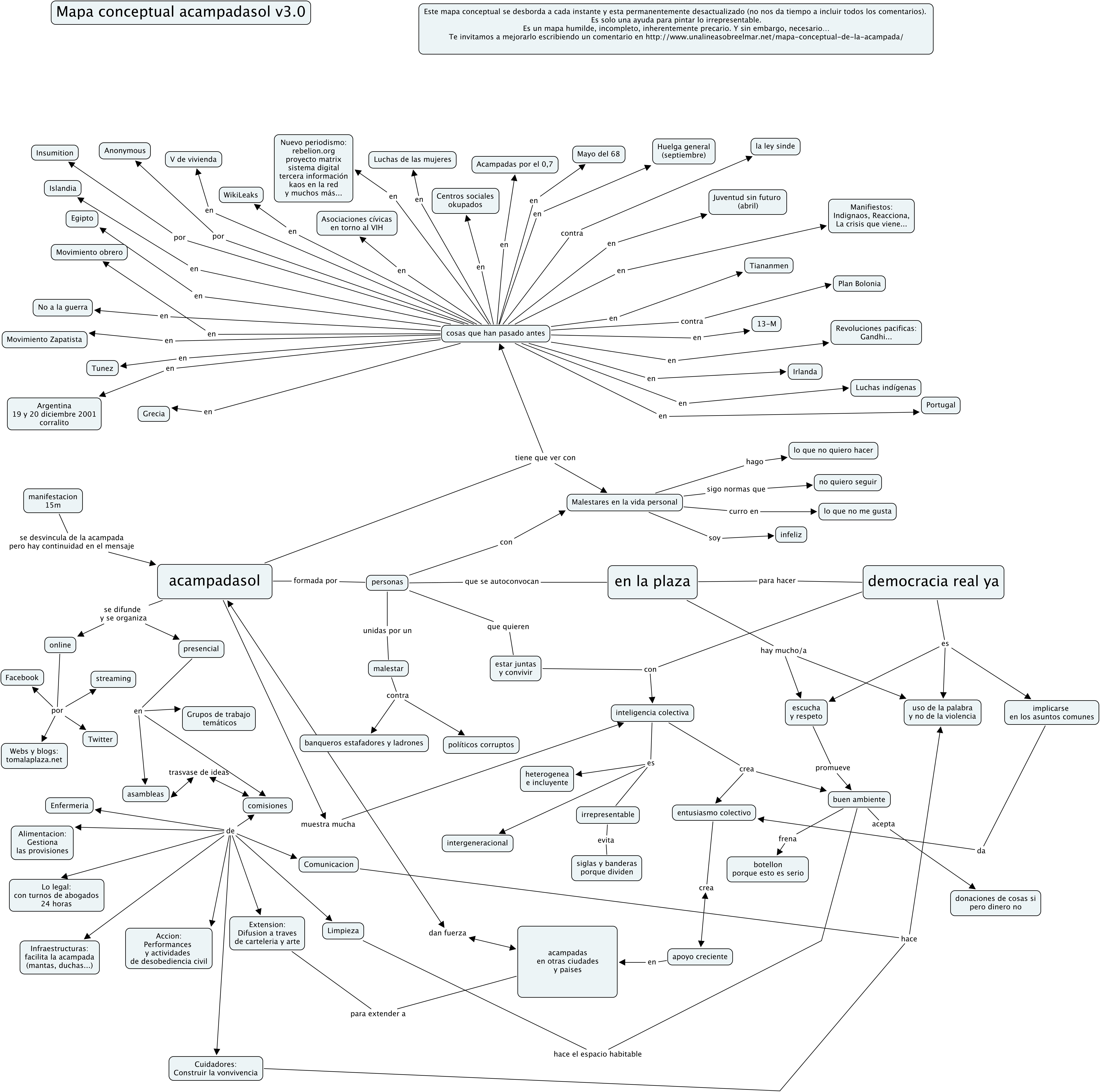
A Conceptual Map of the Real Democracy Now! demonstrations in Spain


While it helps to have a Spanish dictionary at hand, the basic landscape is clear: contemporary events, deeper histories, national and international organizations, actions, and the interweaving of the Net and political life. The map is included in a web site announcing a radio broadcast for Sunday, May 22, linking the various sites of protest around Spain.

Here's the web page:
http://www.unalineasobreelmar.net/2011/05/21/rueda-de-corresponsales-acampadas/

Live video of the Puerta del Sol encampment:
http://www.soltv.tv/soltv2/index.html

While the U.S. media has take little notice of these events (too busy worrying about important matters like Arnold Schwarzenegger's illegitimate child), the BBC lead story this afternoon was a report on widespread demonstrations in Spain and their significance for the upcoming elections.

Thursday, May 19, 2011

Wednesday, May 18, 2011

Manifesto of the Real Democracy Now (¡Democracia Real YA!) movement

Here's the English translation of a Manifesto issued by the movement of unemployed young people and other citizens that is rocking Spain at present. Its points could apply to the U.S.A. and elsewhere, in my view.

Manifesto

We are ordinary people. We are like you: people, who get up every morning to study, work or find a job, people who have family and friends. People, who work hard every day to provide a better future for those around us.
Some of us consider ourselves progressive, others conservative. Some of us are believers, some not. Some of us have clearly defined ideologies, others are apolitical, but we are all concerned and angry about the political, economic, and social outlook which we see around us: corruption among politicians, businessmen, bankers, leaving us helpless, without a voice.
This situation has become normal, a daily suffering, without hope. But if we join forces, we can change it. It’s time to change things, time to build a better society together. Therefore, we strongly argue that:
The priorities of any advanced society must be equality, progress, solidarity, freedom of culture, sustainability and development, welfare and people’s happiness.
These are inalienable truths that we should abide by in our society: the right to housing, employment, culture, health, education, political participation, free personal development, and consumer rights for a healthy and happy life.
The current status of our government and economic system does not take care of these rights, and in many ways is an obstacle to human progress.
Democracy belongs to the people (demos = people, krátos = government) which means that government is made of every one of us. However, in Spain most of the political class does not even listen to us. Politicians should be bringing our voice to the institutions, facilitating the political participation of citizens through direct channels that provide the greatest benefit to the wider society, not to get rich and prosper at our expense, attending only to the dictatorship of major economic powers and holding them in power through a bipartidism headed by the immovable acronym PP & PSOE.
Lust for power and its accumulation in only a few; create inequality, tension and injustice, which leads to violence, which we reject. The obsolete and unnatural economic model fuels the social machinery in a growing spiral that consumes itself by enriching a few and sends into poverty the rest. Until the collapse.
The will and purpose of the current system is the accumulation of money, not regarding efficiency and the welfare of society. Wasting resources, destroying the planet, creating unemployment and unhappy consumers.
Citizens are the gears of a machine designed to enrich a minority which does not regard our needs. We are anonymous, but without us none of this would exist, because we move the world.
If as a society we learn to not trust our future to an abstract economy, which never returns benefits for the most, we can eliminate the abuse that we are all suffering.
We need an ethical revolution. Instead of placing money above human beings, we shall put it back to our service. We are people, not products. I am not a product of what I buy, why I buy and who I buy from.
For all of the above, I am outraged.
I think I can change it.
I think I can help.
I know that together we can.I think I can help.

I know that together we can.

* * * * * *
http://democraciarealya.es/